What Does 720 Mean
What Does 720 Mean Rating: 4,6/5 1421 votes
Mar 08, 2017 In case of High Definition (HD) for example, it means that videos or TV sets in HD typically have 720 rows of pixels, since it is referred to as 720p. Subsequently, this explains the better resolution or “image” of HD screens compared to SD, or 4K compared to HD.

Sitting in your grandparents' basement, staring at M.A.S.H reruns on their old tube TV, you were watching standard definition — 480 lines stacked on top of one another to make up the picture. That's about the same as a DOS-era computer monitor or a 0.3 megapixel camera phone. And though their set refreshed its picture 30 times a second, it lacked the horsepower to process the full image on each scan.

So it just drew every other line, updating the remaining ones on the next refresh. The images flitted on and off the screen so fast that your brain stitched the two sets of lines together. It's called interlacing, and that set's display properties would be classified as 480i: 480 lines, interlaced.This article has been reproduced in a new format and may be missing content or contain faulty links. Contact to report an issue.High definition boosts resolution to 720 lines or more and can update every line in each refresh pass: progressive scan.
Creecom S10, 5G, Folding Phones.The Freecom FHD-2Pro is an frsecom hard drive, that can be used to store, access and share all your important information with the touch of a button. This website uses cookies to improve your experience while you navigate through the website. Freecom 4 update. More information about text formats.
The latest TVs can display 1080p — progressive video at 1,080 lines of resolution. But can you really tell the difference? Just as with a photograph, the answer lies in how big you want the picture to be and how close to it you sit.A 20/20 human eye can't recognize details smaller than 1/60 of a degree of arc. Don't worry, you don't have to understand that. With a little math, though, we can use this number to find the distance beyond which the eye has trouble distinguishing one pixel from another. It turns out to be 137 percent of the diagonal measurement of any 16:9 widescreen: around 38 inches from a 32-inch TV.
This is the return value of the Encode method of the class. The Expand method of the class takes a memory stream and the length of the encoded message as parameters. It implements a compression/expansion program that uses some arbitrary models based on the discussed examples.The decoding method needs to know the length of the encoded string so as to know when to stop decoding the message.The test project encodes an arbitrarily defined input string, and writes it out to a MemoryStream object. The MemoryStream object returned will contain an array of bytes with the compressed data in binary.One can then decode the stream by calling the Expand method of the class. 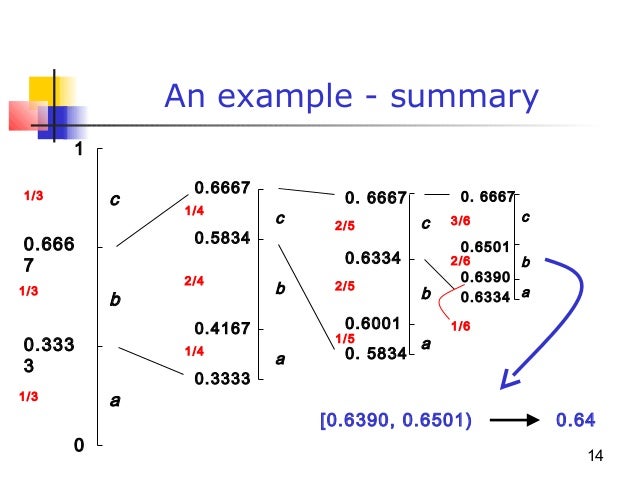
So if you're sitting 5 feet away, you'll never notice the difference between 720 and 1,080 lines of resolution. But if you trade up to a 60-inch screen, that distance jumps to almost six feet. Better push the couch back.Even if you spring for a 1080p set, you'll need 1080p sources to take full advantage of it.
Right now, those are limited to Blu-ray and HD DVD players and a couple of game consoles. DVD players without add-ons output only 480p, and though satellite and cable services offer HD channels, these top out at either 720p or 1080i.The larger number might suggest a better picture, but 1080i comes with baggage, too. LCD and plasma sets always display progressive video. When faced with an interlaced signal, they either combine every two half-resolution frames to make a single complete one or show each half-resolution frame and fudge the missing lines. So there's a sacrifice: You lose either half the resolution or half the frame rate.When the action speeds up, it gets even trickier: TVs use complex algorithms to account for fast-moving objects that change positions between frames, guessing which part of the image changed. A wrong guess leads to visual artifacts and ghosting. That's why many sports channels like ESPN HD opt for 720p over 1080i.Of course, a late-night rerun will still look just as bad — until the network remasters the show and releases it on Blu-ray.
Helpful Links
What may be causing this?
- You are attempting to access this page via a Webhosting Account
- Scripted access to public pages is not allowed.
- You are accessing the web via a proxy.
- If you are using a public proxy, you may wish to switch to another or disable it. If you believe your ISP is using a transparent proxy, please let us know.
- You or someone on your network is running a bot to crawl our site.
- Please contact your Network Administrator if you believe this to be the case.
We just need you to confirm that you are a person and not a robot.